




- Website -







 Current Location:
NEWS INFORMATION
Yuyuan Steel Structure
How to Choose a Steel Structure Manufacturer in China: A Buyer's Complete Guide
AUTHOR:yuyuan DATE:2026-09-20 13:29:42 HITS:76
Introduction
When planning an industrial warehouse, workshop, or commercial building, selecting the right steel structure manufacturer is the single most important decision you'll make. A poor choice can lead to costly delays, quality issues, safety risks, and project failures. But finding a trustworthy steel structure supplier in China's vast manufacturing landscape isn't easy — especially for international buyers who lack local expertise.
As a global steel structure exporter, you're likely weighing options between domestic suppliers, European manufacturers, or Chinese producers. China offers competitive pricing and mature manufacturing capabilities, but navigating the market requires careful evaluation.
This guide provides a practical, step-by-step framework for selecting and working with a steel structure manufacturer in China. We'll cover what to look for, red flags to avoid, how to evaluate quotations, quality control measures, and real questions to ask before signing a contract.
By the end of this guide, you'll have a clear checklist for choosing a reliable steel structure factory that delivers quality products on time and within budget.
Why Choose a Chinese Steel Structure Manufacturer?
China has become the world's largest producer and exporter of steel structure components, accounting for approximately 45-50% of global production capacity. Several factors drive this dominance:
Cost Competitiveness
Raw material advantage: China produces over 50% of the world's steel, providing ready access to raw materials at competitive prices
Labor costs: Manufacturing labor costs remain 30-50% lower than Europe or North America for comparable skill levels
Economies of scale: Large steel fabrication plants achieve significant cost advantages through volume production
Typical savings of 20-40% compared to Western manufacturers, while maintaining international quality standards
Manufacturing Maturity
China's steel structure industry has evolved significantly over the past two decades:
Modern steel fabrication facilities equipped with automated welding, CNC cutting, and robotic painting
Experienced engineering teams familiar with international codes (AISC, Eurocode, BS, AS/NZS)
Established supply chains for materials, coatings, and accessories
Proven track record with major projects worldwide
Complete Service Capability
Leading steel structure manufacturers in China now offer turnkey solutions:
Structural design and engineering
Steel fabrication and quality inspection
Transportation and logistics coordination
On-site installation guidance and technical support
After-sales service and spare parts supply
Key Evaluation Criteria for Steel Structure Manufacturers
When evaluating potential steel structure suppliers, assess each of the following dimensions systematically.
1. Manufacturing Capacity and Facilities
A capable steel structure manufacturer should demonstrate:
Production Equipment:- Automatic submerged arc welding machines for H-beam/I-beam fabrication - CNC plasma/flame cutting machines for precise plate cutting - CNC drill lines for simultaneous multi-hole drilling - Shot blasting machines for surface preparation (Sa2.5 standard) - Spray painting lines or manual painting facilities with quality control - Crane systems for handling heavy sections (50+ ton capacity)
Production Capacity:- Annual output of 30,000-100,000+ tons indicates established capability - Multiple production lines to handle concurrent projects - Warehouse space for raw material storage and finished goods - Equipment maintenance schedules ensuring minimal downtime
Facility Assessment Methods:- Request live video tours (not pre-recorded) - Verify equipment through production records - Check maintenance logs and quality control documentation - Visit in person when project value justifies travel costs
2. Engineering and Design Capability
A comprehensive steel structure project requires strong engineering support:
Design Software:- 3D modeling: TEKLA Structures, SAP2000, MST, or 3D3S - Detailing: TEKLA Detailing for fabrication drawings - Analysis: SAP2000, ETABS, PKPM for structural calculation - BIM capabilities for clash detection and visualization
Engineering Standards:- Familiarity with AISC (American), Eurocode (European), BS (British), or GB (Chinese) codes - Experience obtaining local code approvals in your country - Structural calculation reports with proper stamps from licensed engineers - Optimization capability to reduce steel weight while maintaining safety factors
Documentation Quality:- General arrangement drawings - Assembly drawings for each section - Part drawings for steel fabrication- Bolt lists, welding specifications, paint specifications - Material traceability records
3. Quality Control System
Quality management distinguishes professional steel structure suppliers from amateur operators:
Certifications to Verify:- ISO 9001:2015 Quality Management System (mandatory) - ISO 14001:2015 Environmental Management (preferred) - OHSAS 18001 / ISO 45001 Occupational Health and Safety (preferred) - Specific product certifications for your target market (e.g., CE marking for Europe)
Quality Control Process:- Incoming material inspection with mill certificates - Weld quality control (UT, MT, PT testing per AWS D1.1 or equivalent) - Dimensional accuracy checks at each production stage - Surface preparation and paint thickness verification - Final inspection before shipment with detailed packing lists
Third-Party Inspection:- Willingness to accept SGS, BV, LR, or other third-party inspections - Transparent cooperation with inspection agencies - Documentation of all inspection results
4. Project Experience and References
Track record matters significantly when selecting a steel structure manufacturer:
Portfolio Evaluation:- Projects of similar scale and complexity to yours - Experience in your industry (logistics, industrial, agricultural, commercial) - International project experience, especially in your region - Variety of steel structure types (single-span, multi-span, multi-storey building, large span structure)
Specific Questions to Ask:- "Have you completed projects in [your country]?" - "Can you provide contact details for 3-5 reference clients?" - "What was the total value and tonnage of similar projects?" - "What challenges did you face, and how were they resolved?" - "Were projects delivered on time and within budget?"
Red Flags:- Refusal to provide references - Only domestic project experience for an export steel structure project- Vague answers about project specifics - Portfolio showing inconsistent quality or capabilities
5. Financial Stability
A financially weak steel structure factory poses significant project risks:
Financial Indicators:- Annual revenue trends (stable or growing preferred) - Bank references and credit ratings - Historical on-time delivery rate - Number of concurrent projects (overextension risk)
Payment Terms:- Reasonable payment schedule (typically 30% advance, 60% before shipment, 10% after installation completion) - Avoid suppliers demanding >50% advance payments - Letter of credit acceptance indicates financial professionalism
Understanding Steel Structure Quotations
Comparing quotations from multiple steel structure suppliers requires understanding cost components and common pricing traps.
Typical Cost Breakdown
| Component | Percentage | Notes |
|---|---|---|
| Main steel frame (columns, beams) | 40-50% | Largest cost component; depends on design optimization |
| Secondary steel (purlins, girts, bracing) | 15-20% | C/Z sections, sag rods, tie rods |
| Roof and wall cladding | 15-20% | Thickness, type, insulation significantly affect price |
| Paint and surface treatment | 5-8% | Blast blasting, primer, intermediate coat, topcoat |
| Accessories | 3-5% | Roof vents, gutters, downpipes, doors, windows |
| Transportation | 5-10% | Depends on destination and container loading efficiency |
| Engineering and documentation | 2-3% | Design, calculation reports, drawings |
| Profit margin | 5-10% | Varies by supplier size and project complexity |
Red Flags in Quotations
Unusually Low Prices:- May indicate inferior materials (e.g., lower strength steel than specified) - Insufficient paint system (thin coatings, skipped primers) - Inadequate bracing or design optimization that compromises safety - Hidden costs added later through change orders
Vague Specifications:- Steel grade not specified (should be Q235B, Q345B, or A36, A572-50) - Paint system thickness not stated (should specify micron thickness per coat) - Cladding thickness ambiguous (e.g., "0.5mm" may mean nominal, not actual) - No mention of welding standards or inspection requirements
Missing Items:- Foundation bolt specifications omitted - Fire protection not included (if required by local code) - Installation guidance or supervision not quoted - Third-party inspection costs excluded
Optimization Opportunities
A professional steel structure manufacturer will optimize your design for cost efficiency:
Reduce steel weight through structural analysis (typically 10-20% optimization possible)
Standardize section sizes to reduce fabrication complexity
Optimize container loading to reduce transportation costs by 15-25%
Suggest alternative cladding options balancing cost and performance
Provide value engineering suggestions without compromising safety
Essential Questions to Ask Potential Suppliers
Before selecting a steel structure supplier, ask these critical questions:
Manufacturing Questions
"Can you provide a live video tour of your steel fabrication facilities?"
"What is your annual production capacity in tons?"
"What welding methods do you use for main frames (submerged arc welding, CO2 shielding)?"
"What surface preparation standard do you achieve (Sa2.0 or Sa2.5)?"
"What paint brands do you use (Jotun, PPG, Sherwin-Williams, or domestic)?"
"Do you have experience producing portal frame, space frame, or composite structure designs?"
Engineering Questions
"Which structural design software do you use (TEKLA, SAP2000, PKPM)?"
"Can your engineering team design to [your local code, e.g., AISC, Eurocode, AS/NZS]?"
"Will you provide complete structural calculation reports?"
"Can you handle foundation design, or does that remain our responsibility?"
Quality Control Questions
"What welding inspection methods do you use (UT, MT, PT)?"
"Will you accept third-party inspection by SGS, BV, or other agencies?"
"Can you provide mill certificates for all steel materials?"
"What is your typical dimensional tolerance for fabricated sections?"
Project Management Questions
"What is your typical lead time for a [your project size] steel structure project?"
"Who will be our dedicated project manager, and what is the communication plan?"
"How do you handle shipping and documentation (FOB, CIF, DDP)?"
"Do you provide on-site installation guidance or supervision?"
"What is your warranty policy for structure and cladding?"
"Can you provide references from international clients in [your region]?"
Common Pitfalls to Avoid
Pitfall 1: Choosing Based on Price Alone
The lowest quotation from a steel structure manufacturer often masks hidden costs:
Heavier steel sections than necessary (poor design optimization)
Thinner cladding requiring earlier replacement
Inadequate paint system leading to corrosion
Missing items requiring expensive change orders later
Solution: Compare quotations on an apples-to-apples basis, evaluating total value rather than unit price.
Pitfall 2: Insufficient Due Diligence
Many international buyers have been burned by trading companies posing as steel structure factories:
Small trading offices with rented showroom spaces
No actual manufacturing capability, subcontracting to unknown workshops
Inconsistent quality and unreliable delivery
Solution: Verify manufacturing capability through facility audits, live video tours, and third-party verification. Visit in person for large projects.
Pitfall 3: Poor Communication and Language Barriers
Misunderstandings in specifications lead to incorrect deliveries:
Different units (mm vs inches, metric vs imperial)
Code misunderstandings (GB vs AISC vs Eurocode)
Painting color specifications (RAL numbers not communicated)
Cladding profile names varying by manufacturer
Solution: Establish clear communication protocols, use standardized terminology, and confirm all specifications in writing with drawings.
Pitfall 4: Ignoring Transportation Optimization
Bulk cargo shipping vs container shipping decisions significantly impact costs:
Poor container loading planning wastes space and increases freight costs
Oversized components requiring special transport add expenses
Sequence planning essential for efficient on-site erection
Solution: Work with a steel structure exporter experienced in international logistics and container loading optimization.
Pitfall 5: Underestimating Installation Complexity
Delivery is only half the battle:
Lack of installation guidance leads to errors and delays
Missing or incorrect bolt connections cause erection problems
Dimensional tolerances not coordinated between sections
Solution: Require detailed installation drawings, video guidance, and consider on-site supervision for complex projects.
The Selection Process: Step-by-Step
Here's a recommended process for selecting a steel structure manufacturer:
Step 1: Prepare Your Requirements Document
Compile: - Project location, climate conditions, and seismic category - Building dimensions (length, width, height, span, clear height) - Design loads (wind, snow, seismic, crane, live loads) - Cladding preferences and insulation requirements - Target timeline and budget range
Step 2: Shortlist 3-5 Manufacturers
Research through: - Industry referrals and client references - Online B2B platforms (verify credentials carefully) - Industry exhibitions and trade shows - Professional networks and engineering consultants
Step 3: Request Quotations
Send requirements to each shortlisted steel structure supplier and request: - Detailed technical quotation - Preliminary structural layout and steel tonnage - Manufacturing schedule and delivery terms - Company profile, certifications, and project portfolio
Step 4: Technical Evaluation
Compare technical proposals: - Design approach and code compliance - Steel weight per square meter (reasonable range for the span) - Material specifications (steel grade, cladding thickness, paint system) - Engineering documentation scope
Step 5: Commercial Evaluation
Compare commercial proposals: - Unit prices by component (main frame, secondary, cladding) - Total landed cost (including transportation and insurance) - Payment terms and conditions - Warranty and after-sales support
Step 6: Factory Audit
For projects exceeding $100,000: - Visit shortlisted manufacturers in person - Verify facilities, equipment, and production capacity - Review quality control processes and documentation - Meet the engineering and project management teams
Step 7: Reference Checks
Contact provided references: - Ask about quality, communication, and delivery performance - Inquire about post-installation support - Verify projects were completed in similar climates or conditions
Step 8: Contract Negotiation
Ensure contract covers: - Detailed technical specifications and attached drawings - Material grades, paint systems, and welding standards - Quality acceptance criteria and inspection rights - Delivery schedule with liquidated damages for delays - Payment terms tied to milestones - Warranty periods and after-sales obligations - Dispute resolution mechanism (arbitration recommended)
Quality Control During Manufacturing
Once you've selected a steel structure manufacturer, maintain active quality oversight:
Milestone Inspections
Material Reception: Verify mill certificates, visual inspection of plates and profiles
Fabrication Progress: Random checks of welding quality, dimensional accuracy
Pre-Painting: Verify surface preparation grade (Sa2.5)
Post-Painting: Check dry film thickness, adhesion tests, visual defects
Pre-Shipment: Complete inspection of all components, bolt kits, accessories
Documentation Requirements
Material test reports and mill certificates
Welder qualification records
Welding procedure specifications (WPS)
Paint system data sheets and application records
Dimensional inspection reports
Third-party inspection certificates
Communication Protocol
Weekly progress reports with photos
Video calls for key milestone reviews
Instant messaging (WeChat, WhatsApp) for daily coordination
Document sharing platform for drawings and approvals
Case Study: 8,000m² Steel Warehouse for Distribution in Kenya
Project Background:- Client: East African logistics company - Specifications: 80m × 100m × 10m, single-span, two 10-ton bridge cranes - Budget: Competitive, timeline 16 weeks - Challenge: Previous bad experience with a low-cost Chinese supplier
Selection Process:- Shortlisted 4 steel structure manufacturers in China - Conducted video tours of all 4 facilities - Identified 2 as having adequate capacity and international experience - Final selection based on technical optimization (15% steel weight reduction vs. lowest bidder) - Third-party inspection by SGS arranged
Results:- Steel structure delivered on time, 2 weeks ahead of schedule - All components fit correctly during installation with minimal adjustments - Crane installation ran smoothly due to precise dimensional control - Client established ongoing partnership for 5 additional projects across East Africa
Key Success Factors:- Thorough supplier evaluation beyond price - Technical optimization reducing total cost despite slightly higher unit price - Active quality control throughout manufacturing - Experienced steel structure exporter with African project experience
FAQ: Choosing a Steel Structure Manufacturer
Q: How long does it typically take to manufacture a steel structure project?
A: For a typical 3,000-10,000 m² warehouse, lead time is 8-12 weeks from contract signing and drawing approval. Multi-storey building projects or those with complex heavy steel structure project requirements may take 12-16 weeks.
Q: What steel grades are commonly used?
A: Common grades include Q235B (equivalent to ASTM A36) for lighter structures, Q345B (equivalent to ASTM A572-50) for medium-weight applications, and Q390/Q420 for heavy steel structure project requirements. International projects may specify A36, A572-50, or S275/S355 per Eurocode.
Q: How do I verify a manufacturer's credibility?
A: Request ISO certifications, company business license, factory videos, project references, and third-party audit reports. Visit in person for large investments. Check for memberships in industry associations like the China Steel Structure Association.
Q: What is the typical warranty period?
A: Reputable steel structure manufacturers typically offer 25 years warranty for the main structural frame and 5-10 years for cladding and paint systems, subject to proper installation and maintenance.
Q: Can a Chinese manufacturer design to my local building code?
A: Yes, experienced steel structure exporters work with international codes (AISC, Eurocode, BS, AS/NZS). Ensure your supplier has specific experience with your target code and can provide calculation reports stamped by licensed engineers.
Conclusion
Selecting the right steel structure manufacturer in China requires diligent evaluation of manufacturing capability, engineering expertise, quality control systems, project experience, and financial stability. While cost advantages are significant, the lowest price rarely delivers the best value — optimization, reliability, and after-sales support matter enormously for project success.
As an experienced steel structure manufacturer, exporter, and steel structure supplier serving global markets, YY Steel Warehouse brings comprehensive capabilities from design through delivery. We specialize in custom steel structure project solutions for Africa, Southeast Asia, the Middle East, and beyond — combining competitive pricing with international quality standards and professional project management.
Whether you need a simple prefab steel structure warehouse or a complex heavy steel structure project with multiple cranes and multi-storey building elements, our team is ready to provide optimized solutions that meet your technical requirements, budget, and timeline.
References
China Steel Construction Association — Annual Development Report, 2023
American Institute of Steel Construction (AISC) — Code of Standard Practice for Steel Buildings and Bridges, 2021
World Steel Association — Steel building systems: A comparative guide, 2023
ISO 9001:2015 — Quality Management Systems, International Organization for Standardization
McGraw Hill Construction — Building Product Report: Steel Structural Systems, 2022
-
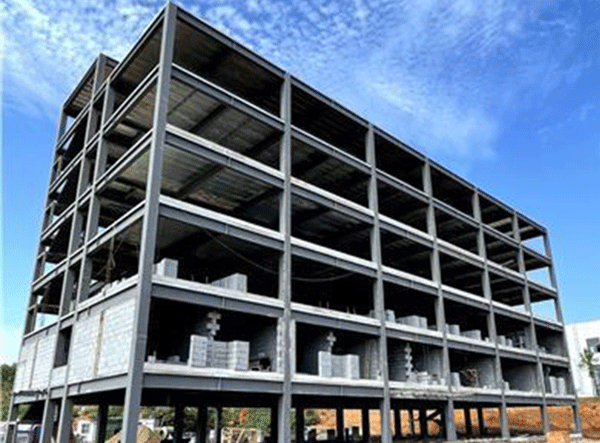
Fast Assembled Multi-Story Steel Structure Workshop Factory For Industrial Use
-
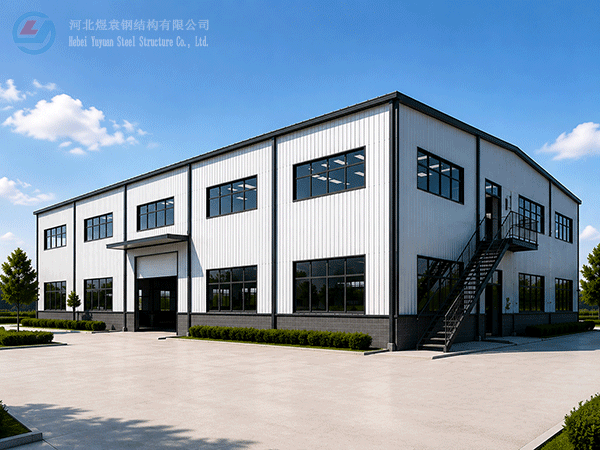
Modern Two-Storey Prefabricated Steel Structure Workshop Building Industrial Shed Construction
-

Yuyuan export Steel Structure Warehouse Prefab Steel Structure Warehouse for storage
-
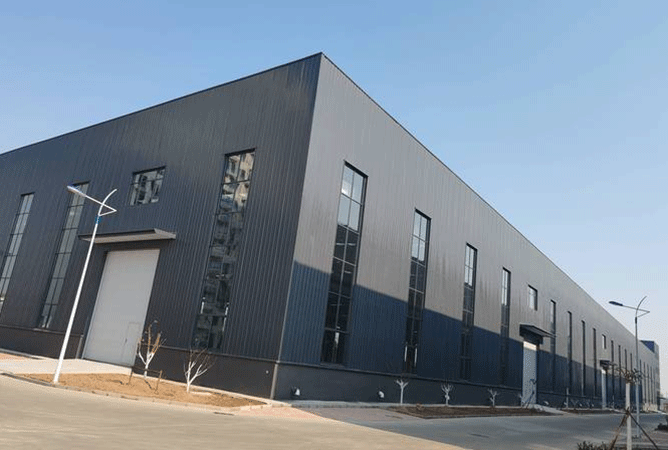
Export steel structure workshops Prefabricated steel structure workshops Light steel structure war
-
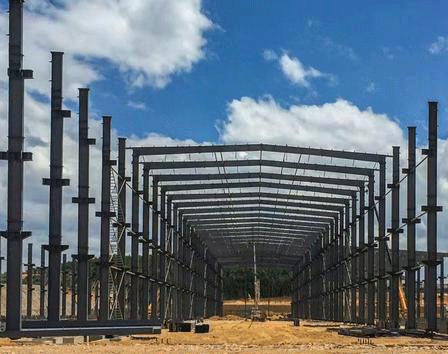
High Quality Low Cost Prefabricated Steel Structure Industrial Warehouse Shed
-

Xiao Sheng - Maldives
-

Xiao Sheng - Maldives
-

Xiao Sheng - Maldives
Hebei Yuyuan Steel Structure Co., Ltd.
Copyright © 2024-2025 https://www.yysteelwarehouse.com. All Rights Reserved Hebei Yuyuan Steel Structure Co., Ltd. All Rights Reserved.